Invitation-only betaGCSE and International GCSE
Know what they know. Teach what they don’t.
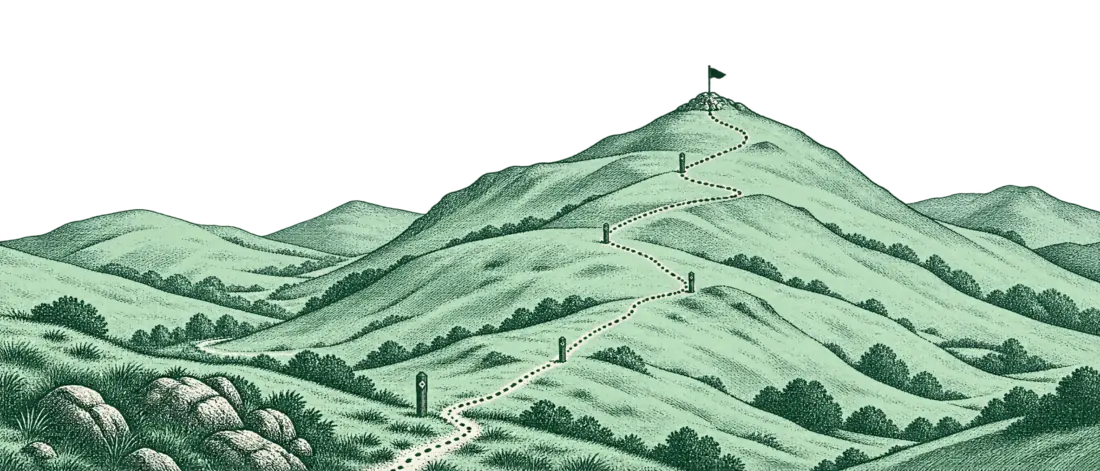
Fathomtrail is a personal tutor for GCSE and International GCSE. It finds out what your teenager already knows, teaches the gaps by asking before it explains, and brings each topic back before it fades, on the exact course their school teaches.
£19.99 a month for up to 4 childrenChildren sign in with a PIN, no emailThe AI asks; it never marks

- 42GCSE and International GCSE courses taught
- 20subjects, from Maths to Food Preparation
- 239past and specimen papers mapped, question by question
- 4exam boards: AQA, Eduqas, OCR and Pearson Edexcel
The usual way
Most revision starts in the wrong place.
Re-reading feels like work
Highlighting and re-reading notes are among the least effective ways to learn. Testing yourself, and spacing it out, are among the most effective.
Dunlosky et al., 2013
Generic practice misses their course
Questions written for “GCSE Biology” are not written for their board, their tier or the options their school chose.
Chatbots hand over answers
It feels like help, but when AI does the thinking, pupils can do worse once it is taken away. More on that below.
Fathomtrail starts with what they don’t know, works on their course, and leaves the thinking to them.
How it works
Four steps, on every topic, in every subject.
The same method runs through every course, built on decades of research into how memory works. It starts with what your child already knows, so the time goes on what they don’t know yet.

It checks first
A topic starts by finding out what is already there: how sure they feel, what they can recall, and questions they have never seen. Whatever they already know, they skip.
It asks before it tells
Each step opens with a guiding question, and the explanation follows their attempt. If they are stuck, a worked example and a similar question get them moving again.
Only their own answers count
A topic becomes known only from answers given right first time, without help, or from work done without help that an adult has marked. Hints, retries and AI feedback help them learn, and never count as proof.
It comes back before it fades
A memory model schedules each recheck for when a topic is about to slip, with questions they have not seen before, so what they learn in October has the best chance of lasting to May.
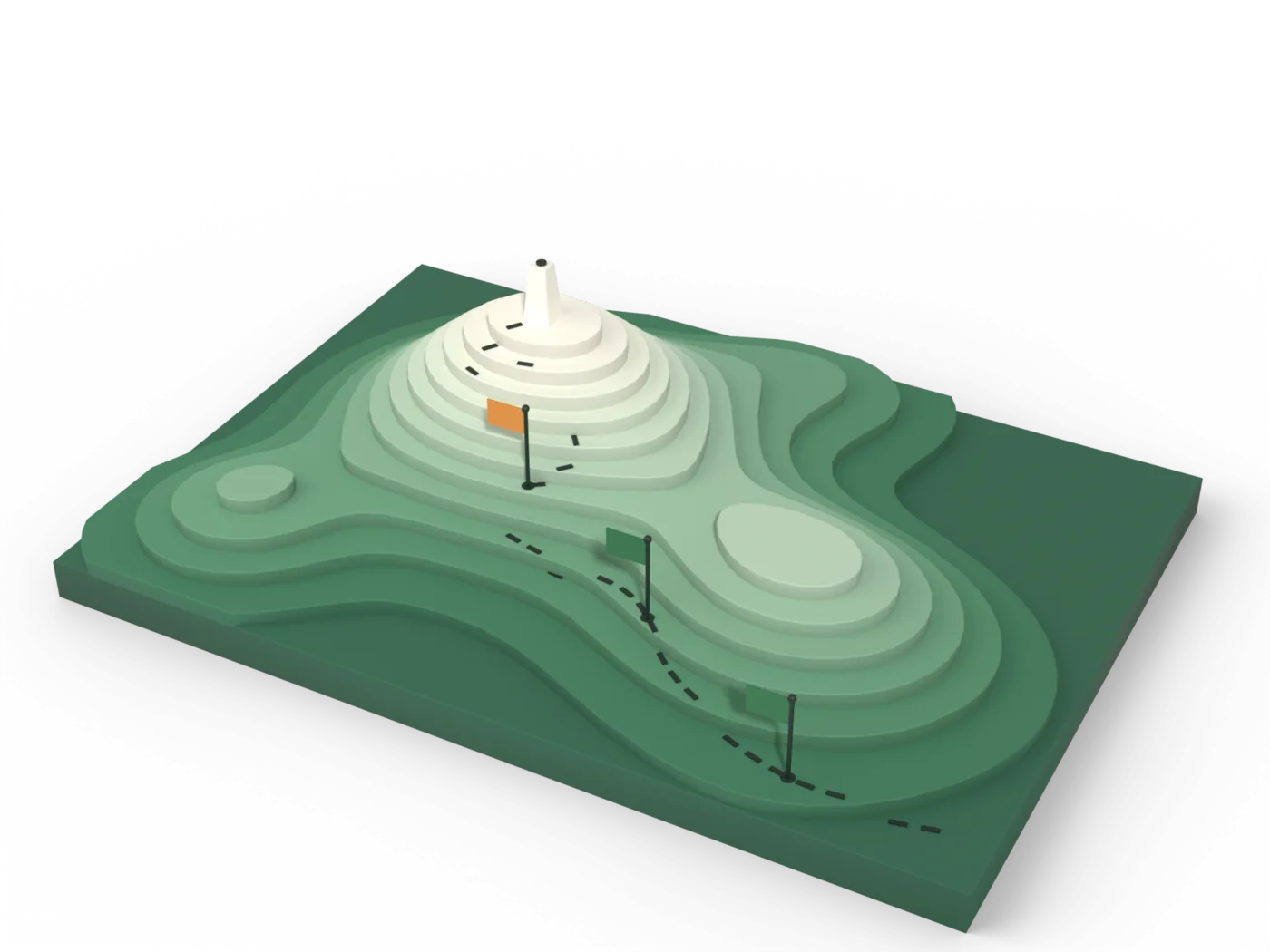
The knowledge map
Known. Not known. Not yet checked.
Every topic in every course sits in one of three states, and only evidence moves it. The plan goes to the gaps first. Known topics come back only for spaced rechecks.
Confidently wrong comes first
An answer they were sure of but got wrong points to a misconception, so it goes to the front of the plan.
Teaching aimed at the gap
Lessons start from the questions they missed and what they said they were unsure of, not from page one.
Honest about progress
No predicted grades and no flattering percentages. Just what they can do on their own, and what comes next.
Subjects and exam boards
Their subjects. Their exact specification.
Choose the board, the tier and your school’s options, or settle them later. Everything they are taught, checked and asked follows that course and nothing else.
Maths
- AQA
- 8300
- Pearson Edexcel
- 1MA1
- Pearson Edexcel International
- 4MA1
More than 100 topics, and every session picks questions they have not seen before. Graphs, constructions and Venn diagrams are drawn and marked on screen; proofs come to you to mark.
Foundation and Higher

Biology, Chemistry, Physics and Combined Science
- AQA
- 8461 · 8462 · 8463 · 8464
- Pearson Edexcel
- 1BI0 · 1CH0 · 1PH0 · 1SC0
- Pearson Edexcel International
- 4BI1 · 4CH1 · 4PH1 · 4SD0
A check before every unit, then lessons aimed at the gaps. Answers with units and standard form, chemical formulae, and the method behind the required practicals.
GCSE Foundation and Higher

English Language and Literature
- AQA
- 8700 · 8702
- Pearson Edexcel
- 1EN0 · 1ET0
- Pearson Edexcel International
- 4EA1 · 4ET1
Reading, writing, set texts and unseen poetry, with exam practice in the board’s own format. You or their teacher mark it strand by strand.

History
- AQA
- 8145
- Pearson Edexcel
- 1HI0
- Pearson Edexcel International
- 4HI1
Only your school’s options are taught, with practice for every question type. Exam answers are marked by you against the mark scheme, never by the AI.

German, French and Spanish
- AQA
- 8662 · 8652 · 8692
- Pearson Edexcel International
- 4GN1
Vocabulary asked before it is taught, grammar, sounds and themes, with recorded speaking answers for you to mark. AQA German (8662) adds read-aloud practice with pronunciation feedback and a conversation partner.
Computer Science
- OCR
- J277
- AQA
- 8525
- Pearson Edexcel
- 1CP2
- Pearson Edexcel International
- 4CP0
Python or OCR’s reference language. The AQA and OCR courses build logic circuits and flowcharts on screen. Programs are marked by a person.

Design and Technology
- AQA
- 8552
- Pearson Edexcel
- 1DT0
The written exam, unit by unit: a check first, then lessons on the gaps. Written answers are marked by a person. The NEA stays with school.

Drama
- Eduqas
- C690QS
- AQA
- 8261
The written exam and the live theatre review, with lessons on set plays (not yet every play on each list). Devising and performance stay with school.
Geography, Religious Studies, Business, PE, Food Preparation and Nutrition, and Art and Design
- AQA
- 8035 · 8062 · 8582 · 8585 · 8201
- Pearson Edexcel
- 1BS0
Topic teaching on the same method: a check first, then lessons on the gaps, following your school’s options in Geography and Religious Studies. Written answers are marked by a person. Fieldwork, coursework, practical work and the Art portfolio stay with school.
“Pearson Edexcel International” means International GCSE. Practicals, coursework, spoken assessments and performance stay with school. Fathomtrail is not affiliated with or endorsed by any exam board.
Inside Fathomtrail
Everything between the lesson and the exam.
Teaching is only the start. These are the parts that turn a lesson into marks on the day, and they all feed the same plan.
Real past papers, marked into the plan
239 official past and specimen papers across 15 courses, mapped question by question. They sit one at home against the clock, you enter the marks, and every lost mark opens a gap.
Answers they can draw
Graphs, constructions, number lines, circuits, ray diagrams, logic gates and flowcharts, drawn on screen and checked exactly.
German, out loud
In AQA German: read-aloud practice with pronunciation feedback, a conversation partner, and exam-style speaking answers recorded for you to mark.
About twenty minutes a day
In steps of about ten minutes, in order: saved work first, then the gaps, then the rechecks that are due.
Flashcards, properly spaced
Make sets, or bring them in from Quizlet, Anki or a spreadsheet. Six ways to study, spaced by the same memory model.
Written work, marked by a person
Essays, explanations, programs and translations come to you or their teacher with the marking points alongside. The AI never sets the mark.

The app itself
What you and your children see.
Real screens from Fathomtrail, showing a made-up family.
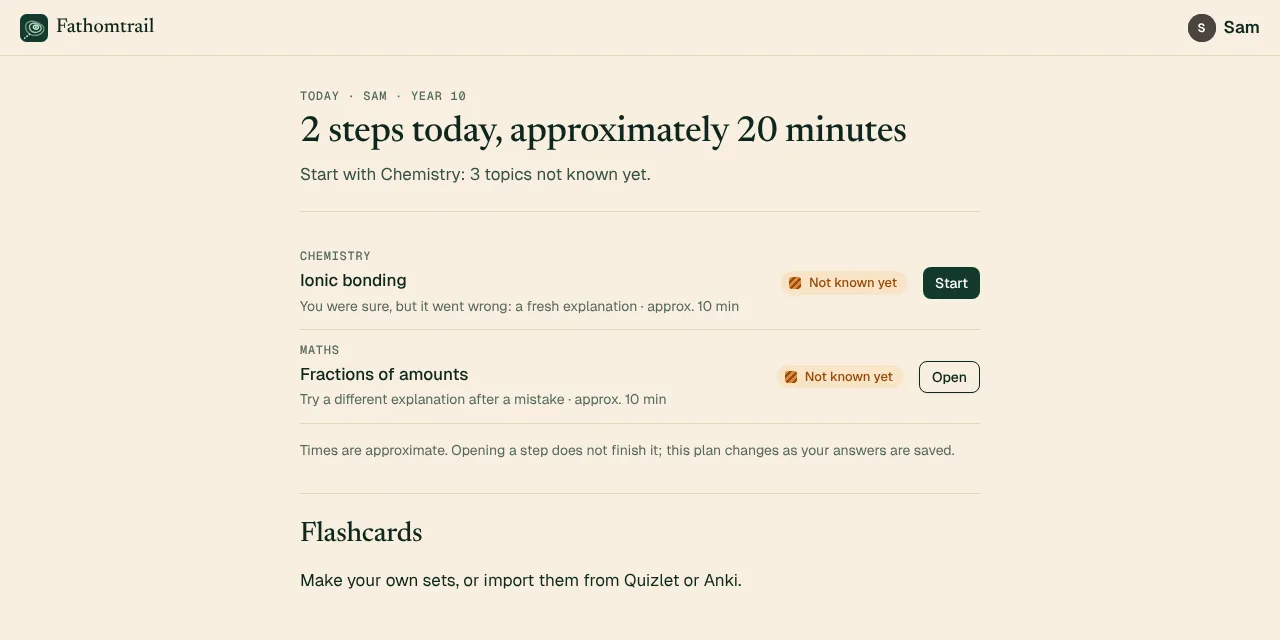
A child’s plan for today 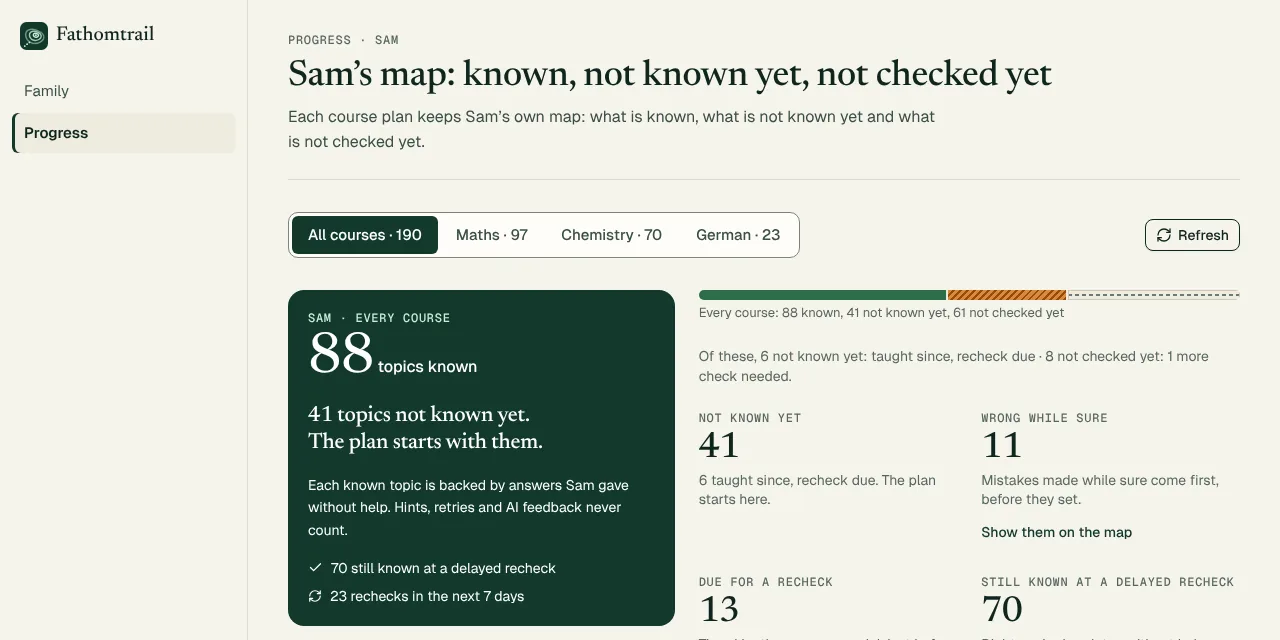
Progress, topic by topic 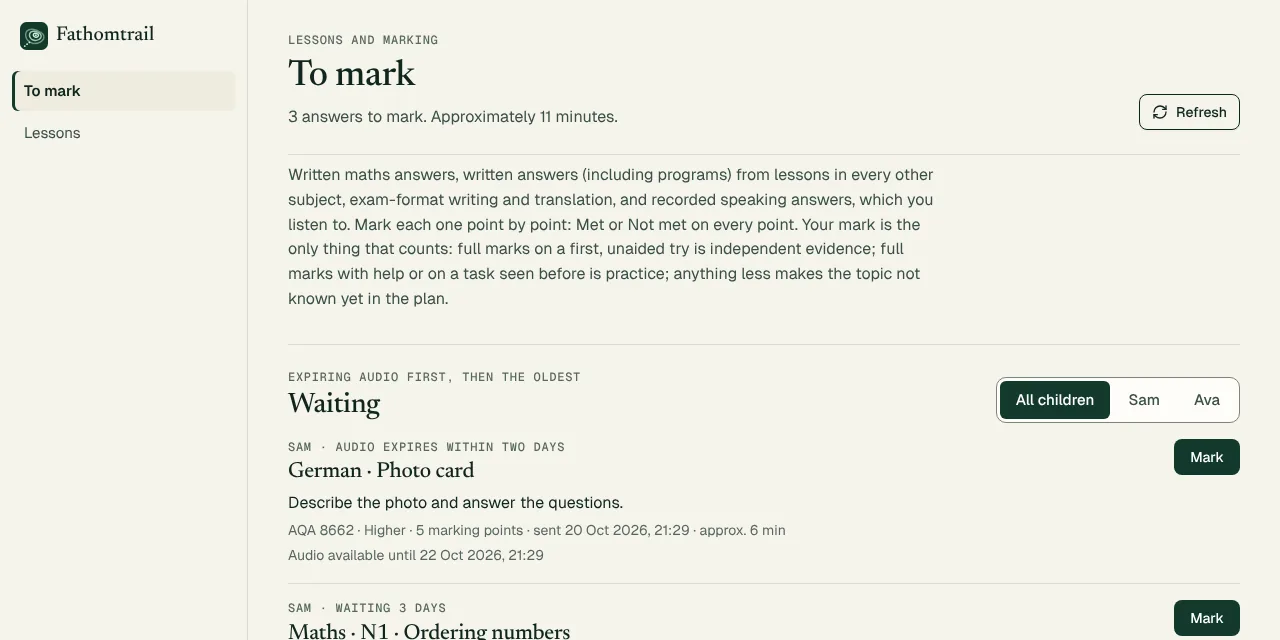
Answers waiting for you to mark
For parents
A straight answer to “how’s revision going?”
See what each child can do on their own, where they needed help and what comes next, in every subject they take.
Every subject in one view
Known, not known and not yet checked, for each child and each course, with the next exam date from the board’s published timetable.
The full record
Every answer and every conversation with the tutor. Owners and parents can download the family’s record at any time.
Your judgement where it matters
Lessons are taught once they are approved: by our team as we publish them, or by you if you choose to approve each one yourself. You mark written and spoken answers with the marking points beside you.
No email for your children
You add each child. They sign in with your family code and their own PIN, or you hand over your own device.
Their tutor too, free
Invite their teacher or tutor to review lessons and mark, at no cost. A tutor can work with several families from one sign-in.

AI, used carefully
An AI tutor that never marks its own homework.
AI is good at asking the next question and spotting a misunderstanding. It is not trusted to decide what your child knows. That stays with checked answers, and with you.
What the AI does
- Asks a guiding question, then responds to your child’s answer
- Helps them see where their thinking went wrong
- Aims its questions at the gaps in their map
- Gives feedback while they practise
What it never does
- Decides which answers count
- Marks a topic as known
- Sets the marks that steer the plan
- Predicts a grade
17%
In a study of about a thousand secondary pupils, those who practised maths with an unrestricted AI chatbot did 17% worse on a later exam taken without it. A version built to guide rather than tell largely avoided the drop. Fathomtrail is built to guide.
Bastani et al., Proceedings of the National Academy of Sciences, 2025
You can see everything
Progress, the full record and every tutor conversation. Your child’s account page tells them so.
Their name stays out of it
Requests to the AI tutor leave out your child’s name and ask the provider not to store them.
Nothing built to hook them
No adverts, no leaderboards and no streaks. Just the next useful step.
Your family’s record
Owners and parents can download it at any time. The microphone is optional, and recordings are deleted on a schedule.
The learning science
Built on how memory works, not on hunches.
These methods have decades of evidence behind them. Fathomtrail uses them together, in the right order, on every topic.
Pretesting
Trying questions before a lesson, even getting them wrong, helps the lesson stick.
Every topic starts with a check.
Richland, Kornell & Kao, 2009
Retrieval practice
Pulling an answer out of memory strengthens it far more than reading it again.
Questions, not notes, do the work.
Roediger & Karpicke, 2006; Dunlosky et al., 2013
Spaced repetition
Reviewing just before something would be forgotten makes it last for months.
FSRS, an open-source memory model, times every recheck.
Cepeda et al., 2006; Ye, Su & Cao, 2022
Interleaving
Mixing topics trains the skill exams test hardest: knowing which method to use.
Maths reviews mix topics up.
Rohrer & Taylor, 2007
Worked examples
Studying a solved problem, then trying a similar one, builds skill without overload.
Stuck? A worked example, then a fresh question.
Sweller & Cooper, 1985
Confidence ratings
Mistakes made with high confidence are corrected more strongly once the reason is clear.
Confidently wrong answers come first.
Butterfield & Metcalfe, 2001

Why we built it
Fathomtrail began as a tutor for one family: ours. We wanted something that would find out what our children really knew before teaching them anything, spend their time on the rest, and tell us the truth about how it was going. It works on their exact courses, across the subjects they take. Now we’re opening it, carefully, to more families.
The family behind Fathomtrail
Pricing
One plan for the whole family.
One subscription covers up to 4 children and every subject they take. When sign-up opens, every new family will start with a 14-day free trial, with no card.
Family plan
£19.99a month, or £179 a year
- One plan for the whole family
- Up to 4 children, every subject
- Teachers and tutors you invite are free
Founding families
£12.99a month, or £119 a year
- For families who joined during the invitation-only beta
- Kept for good once your family has it
- Up to 4 children, every subject
Teachers and tutors
Freewhen a family invites you
- Review lessons and mark answers
- Work with several families from one sign-in
- Never billed
Prices are in pounds. The family’s owner chooses a plan in Settings › Billing, during the trial or after it, and payments are handled by Stripe. Your records stay until you delete them.
Join the beta
Request your invite.
We are inviting families a few at a time so we can listen and improve. Leave your email and we will email you if a place opens.
- Families invited during the beta have the founding price, kept for good
- For parents, carers, teachers and tutors
- Adult details only: no child names needed
Already have an invitation? Sign in
Questions
Good questions to ask before you join.
Which subjects and exam boards does it cover?
42 GCSE and International GCSE courses across 20 subjects, from AQA, Eduqas, OCR and Pearson Edexcel: Maths, Biology, Chemistry, Physics, Combined Science, English Literature, History, Computer Science, Drama, Art & Design, German, Design and Technology, English Language, Geography, Religious Studies, French, Spanish, Physical Education, Food Preparation and Nutrition, Business. Practicals, coursework, fieldwork, spoken assessments and performance stay with school. Pearson Edexcel GCSE German (1GN1) has a syllabus checklist only for now.
How do children sign in?
You add each child (up to 4) with a nickname and school year: they need no email address or Google account. They sign in with your family code and a 6-digit PIN you set, or you hand over your own device. Too many wrong PINs pause sign-in on that device for a while; after 20 wrong tries in a day, the child’s sign-in is locked until a parent unlocks it.
Who sees what?
The family’s owner and parents see each child’s progress, every answer and every conversation with the tutor, and can download the family’s record. A teacher or tutor you invite sees the same work so they can review lessons and mark, but cannot download the record or change the family. Each child sees only their own work.
Is the AI doing their work for them?
No. The tutor asks questions and responds to your child’s thinking. The AI never decides what is right, never marks a topic as known and never predicts a grade. Only answers your child gets right first time on their own, and work done without help that an adult has marked, count.
How will I know it is working?
The knowledge map shows every topic as known, not known or not yet checked, and it changes only with evidence: answers given right first time without help, or work done without help that an adult has marked. Rechecks weeks later show what has stuck.
What do I need to do as a parent?
Add your children, choose their courses and set their PINs. If you do not know the board, tier or school options yet, teaching starts anyway and you can settle them with the school later. Then mark written and spoken answers with the marking points in front of you, or invite their teacher or tutor to share it.
What happens when the free trial ends?
The trial lasts 14 days and needs no card. Nothing is charged at the end: your family becomes read-only, so you can still see your family’s records, download them and delete them, but nothing new is added until the family has a plan. The family’s owner chooses one in Settings › Billing, during the trial or after it.
How much does it cost?
One family plan covers every subject and up to 4 children: £19.99 a month or £179 a year. Founding families (families who joined during the invitation-only beta) pay £12.99 a month or £119 a year, and keep that price for good. Teachers and tutors you invite are free.
How do I cancel?
The family’s owner can cancel at any time in Settings › Billing: Manage payment or cancel opens the billing page Stripe provides. The plan stops renewing and full access carries on until the end of the month or year already paid for; then the family becomes read-only. Cancelling deletes nothing: your records stay until the owner deletes them.
What happens to our data?
Requests to the AI tutor leave out your child’s name and ask the provider not to store them. The microphone is optional, and recorded answers for marking are deleted 30 days after they are marked, or after 90 days if they are never marked. Read the privacy notice, the notice for children and the Terms.
Does it replace school or a tutor?
No. It follows the course your child takes at school, and their teacher or tutor can join free to review and mark. Teacher judgement remains essential.
Is it only for GCSEs?
GCSE and International GCSE are where we are starting. We aim to support learning across more qualifications and stages of education, with the same method. Further courses and dates are not confirmed yet.
Find the gaps while there’s time to fix them.
The summer exams start in May. Every week before then is a chance to turn a gap into something known.
Request an invitation